Grafton Bridge

Grafton, AUCKLAND

Historic Place Category 1

List No. 16

Quick links:
Grafton Bridge was at the forefront of construction technology when it was built in 1907-1910, having the world's largest single span of reinforced concrete. Occupying a dramatic position across Grafton Gully in Auckland, the bridge was commissioned by the local council to link the city centre with the new hospital and sports grounds in Auckland Domain. Its construction was part of a programme of regional roadbuilding, and was seen to symbolise both the creation of a 'Greater Auckland' and state leadership in the development of technology. Sanctioned by ratepayers at the very end of the British colonial period (1840-1907), it also displayed the new Dominion's ability to lead the world in its progressive outlook. The work was started by the Ferro-Concrete Company of Australasia, but was completed by council staff after the scale of the project bankrupted the initial contractors.

The bridge has a large central span of 97.6 m, with three smaller spans on its eastern approach and six on its west. It is 296 m long and built entirely of reinforced concrete, with the girders in its approaches being claimed as the longest continuous segments in the world at the time. Electric street lighting - which was unusual in the early 1900s - lit the raised pavements and provision was made for two-way road traffic. Little maintenance was required in its first decades, although two programmes of repair were carried out in the 1930s and 1950s. The bridge is still used as a major thoroughfare, and has seen further small modifications in the 1990s.

Grafton Bridge is of national and international significance for its use of advanced concrete technology, and is an important symbol of national and civic pride. It has considerable value as a major construction project, instigated and completed by local government authorities. The structure provides valuable information about the development of road transport, and was the first major road bridge in Auckland. It has played a significant role in the lives of ordinary Aucklanders as a link to Auckland Hospital and the recreation grounds in the Auckland Domain. Constructed with its foundations in an early colonial cemetery, it demonstrates early twentieth-century civic attitudes to the past and to the dead. It has considerable value as a prominent landmark, and is part of a larger historical landscape that includes Symonds Street cemetery.
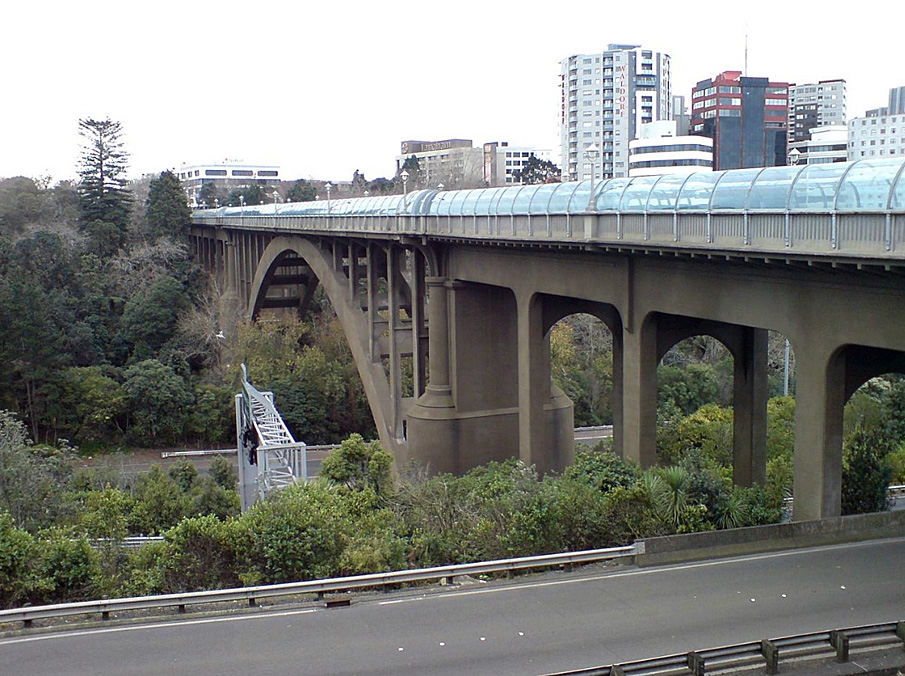
Grafton Bridge, Auckland. View from west side. Image courtesy of commons.wikimedia.org | Ingolfson | 01/01/2010 | Public Domain
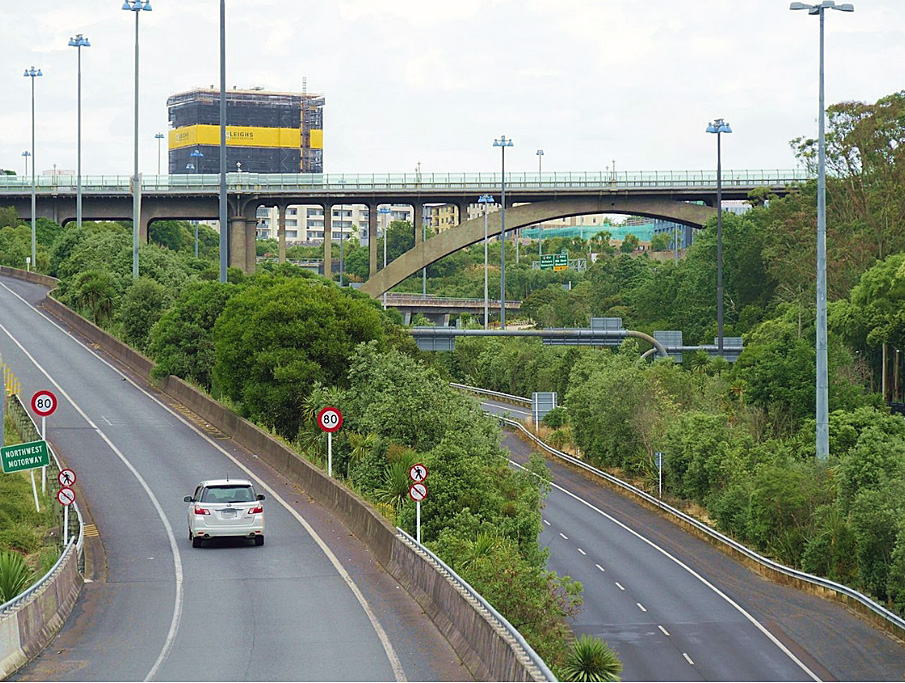
Grafton Bridge, Auckland. CC Licence 2.0 Image courtesy of commons.wikimedia.org | Ulrich Lange | 03/01/2017 | Ulrich Lange Bochum Germany
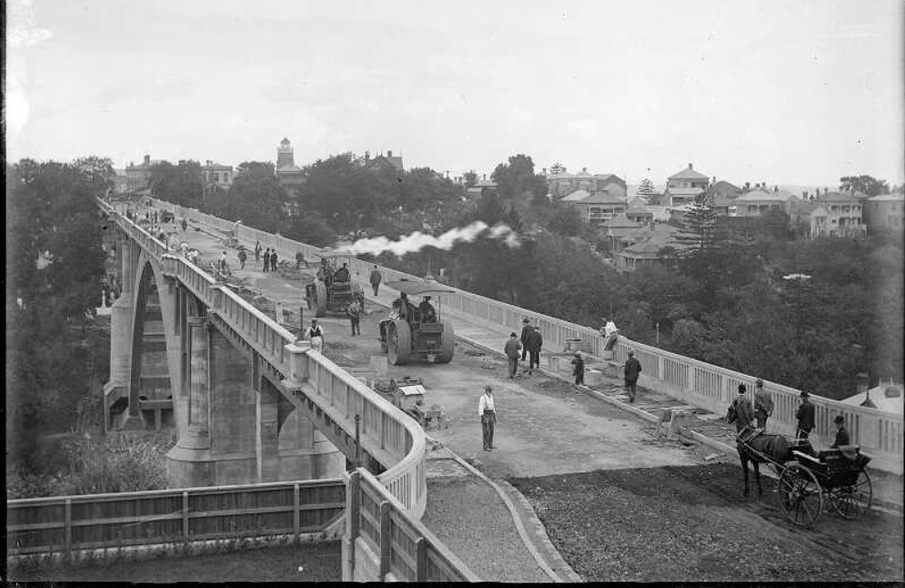
Grafton Bridge, Auckland. c.1910. Under construction. Ref: 1/2-000889-G. Alexander Turnbull Library, Wellington, New Zealand. /records/22788121 | William Price | Alexander Turnbull Library, Wellington
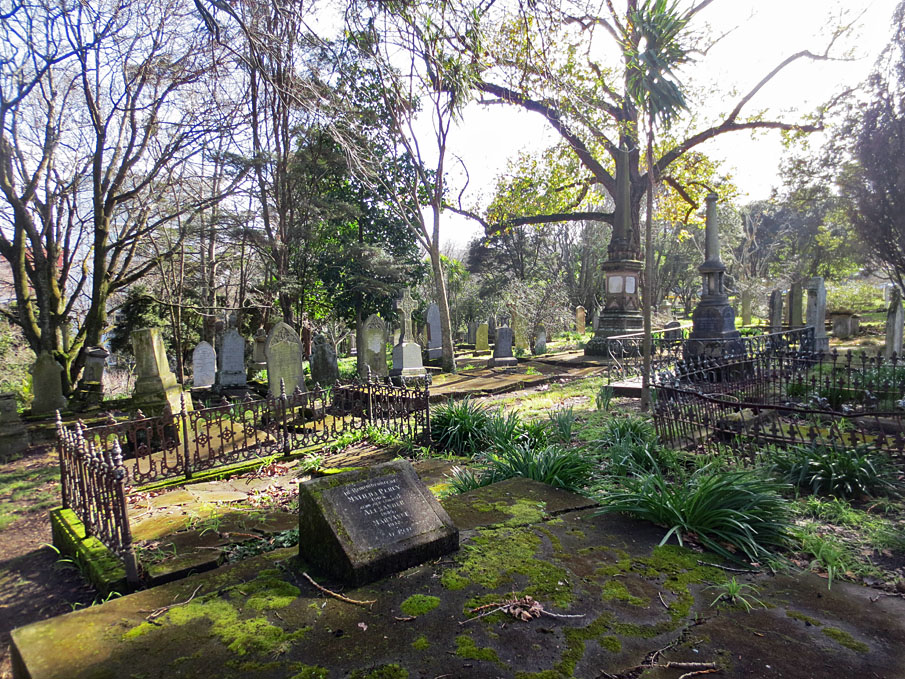

List Entry Information

Overview

Status

Listed

List Entry Status

Historic Place Category 1

Access

Able to Visit

List Number

16

Date Entered

23rd June 1983

Date of Effect

23rd June 1983

City/District Council

Auckland Council

Region

Auckland Council

Legal description

Pt Lot 2 DP 18958, Symonds Street Cemeteries Public Reserve (Cemetery), Statutes 1908 p.315; Pt Lot 34 DP 146 Motorway Purposes, NZ Gazette 1990 p.1602; Lots 32 33 & Pt Lot 34 DP 146 Motorway, NZ Gazette 1984 p.3693

Status

Listed

List Entry Status

Historic Place Category 1

Access

Able to Visit

List Number

16

Date Entered

23rd June 1983

Date of Effect

23rd June 1983

City/District Council

Auckland Council

Region

Auckland Council

Legal description

Pt Lot 2 DP 18958, Symonds Street Cemeteries Public Reserve (Cemetery), Statutes 1908 p.315; Pt Lot 34 DP 146 Motorway Purposes, NZ Gazette 1990 p.1602; Lots 32 33 & Pt Lot 34 DP 146 Motorway, NZ Gazette 1984 p.3693

Construction Information

Construction Professional

Name

Moore, Robert Forbes

Type

Engineer

Biography

Robert Forbes Moore (c.1865 -1938) was born in South America and educated in England, later joining the Royal Engineers. After moving to Australia, he became involved in mining engineering. In the early 1900s he was employed by the Ferro-Concrete Company of Australasia, becoming its engineer-in-chief based in Auckland. While in this position, Moore was responsible for overseeing the company’s construction of extensive works along Auckland’s waterfront, including the Railway (later King’s) Wharf extension in 1904-8, the Ferry Jetty in 1907, and early parts of the Queens Wharf in 1907-9. He also oversaw the construction of early reinforced concrete buildings in Auckland such as the Northern Roller Mills building (1907-8), and a breakwater extension and new wharf for the Napier Harbour Board (c. 1906). Prior to the liquidation of the Ferro-Concrete Company in 1909, Moore was also responsible for the design and initial construction of the Grafton Bridge, Auckland, which had the largest reinforced concrete span in the world when built. He later oversaw construction of the first Mangere Bridge, built in reinforced concrete in 1914-15, and undertook other work in the Auckland region. He died in Auckland in 1938, aged 73.

Construction Details

Start Year

1907

Finish Year

1910

Type

Original Construction

Start Year

1930

startYearCirca

Finish Year

1960

finishYearCirca

Type

Modification

Description

Repair of approaches

Start Year

1997

Type

Addition

Description

Provision of replica street lights

Notable Features

Registration covers the structure, its fixtures and finishes, as well as its footings. It also includes recent modifications.

Construction Professional

Name

Moore, Robert Forbes

Type

Engineer

Biography

Robert Forbes Moore (c.1865 -1938) was born in South America and educated in England, later joining the Royal Engineers. After moving to Australia, he became involved in mining engineering. In the early 1900s he was employed by the Ferro-Concrete Company of Australasia, becoming its engineer-in-chief based in Auckland. While in this position, Moore was responsible for overseeing the company’s construction of extensive works along Auckland’s waterfront, including the Railway (later King’s) Wharf extension in 1904-8, the Ferry Jetty in 1907, and early parts of the Queens Wharf in 1907-9. He also oversaw the construction of early reinforced concrete buildings in Auckland such as the Northern Roller Mills building (1907-8), and a breakwater extension and new wharf for the Napier Harbour Board (c. 1906). Prior to the liquidation of the Ferro-Concrete Company in 1909, Moore was also responsible for the design and initial construction of the Grafton Bridge, Auckland, which had the largest reinforced concrete span in the world when built. He later oversaw construction of the first Mangere Bridge, built in reinforced concrete in 1914-15, and undertook other work in the Auckland region. He died in Auckland in 1938, aged 73.

Construction Details

Start Year

1907

Finish Year

1910

Type

Original Construction

Start Year

1930

startYearCirca

Finish Year

1960

finishYearCirca

Type

Modification

Description

Repair of approaches

Start Year

1997

Type

Addition

Description

Provision of replica street lights

Notable Features

Registration covers the structure, its fixtures and finishes, as well as its footings. It also includes recent modifications.

Reference

Historical and Associated Iwi / Hapū / Whānau

Completion Date

21st August 2001

Report Written By

Martin Jones

Information Sources

Bush, 1971

G .W. A. Bush, 'Decently and In Order: The Government of the City of Auckland 1840-1971', Auckland, 1971

Reed, 1955

A. W. Reed, Auckland: City of the Seas, Wellington, 1955

Thornton, 2001

Geoffrey Thornton, Bridging the Gap, Early Bridges in New Zealand 1830-1939, Auckland, 2001

Thornton, 1996

Geoffrey Thornton, Cast in Concrete: Concrete Construction in New Zealand 1850-1939, Auckland, 1996

Other Information

This place was identified as significant under previous legislation with different information requirements. It remains significant under the current legislation. There is opportunity under our legislation and policies to add to this information. Further information about this place may be available from the Northern Regional Office of Heritage New Zealand Pouhere Taonga. Please note that entry on the New Zealand Heritage List/Rarangi Korero identifies only the heritage values of the property concerned, and should not be construed as advice on the state of the property, or as a comment of its soundness or safety, including in regard to earthquake risk, safety in the event of fire, or insanitary conditions.

Historical and Associated Iwi / Hapū / Whānau

Completion Date

21st August 2001

Report Written By

Martin Jones

Information Sources

Bush, 1971

G .W. A. Bush, 'Decently and In Order: The Government of the City of Auckland 1840-1971', Auckland, 1971

Reed, 1955

A. W. Reed, Auckland: City of the Seas, Wellington, 1955

Thornton, 2001

Geoffrey Thornton, Bridging the Gap, Early Bridges in New Zealand 1830-1939, Auckland, 2001

Thornton, 1996

Geoffrey Thornton, Cast in Concrete: Concrete Construction in New Zealand 1850-1939, Auckland, 1996

Other Information

This place was identified as significant under previous legislation with different information requirements. It remains significant under the current legislation. There is opportunity under our legislation and policies to add to this information. Further information about this place may be available from the Northern Regional Office of Heritage New Zealand Pouhere Taonga. Please note that entry on the New Zealand Heritage List/Rarangi Korero identifies only the heritage values of the property concerned, and should not be construed as advice on the state of the property, or as a comment of its soundness or safety, including in regard to earthquake risk, safety in the event of fire, or insanitary conditions.

Further Information

Current Usages

Uses: Transport

Specific Usage: Bridge/ Viaduct

Current Usages

Uses: Transport

Specific Usage: Bridge/ Viaduct

Stay up to date with Heritage this month